Tuesday, November 14, 2017

Social Media: Under the Microscope

After taking a look at a few social media sites, I have toggled through and explored to give an in-depth look at my experiences with them. Here's what I have found...


FaceBook/YouTube/Pinterest Compare & Contrast


LinkedIn

LinkedIn is a wonderful site that allows people to connect with one another on a professional level. It can be helpful to your career by giving you a great platform to show your professional and educational accomplishments, similar to that of a résumé format. The best way to utilize this site to the fullest is to make sure that you generate high quality content that covers all of your best attributes and work experience. 

Skype

As a great medium to utilize VOIP technology, Skype is a way to see people while you talk to them. It is beneficial because it allows friends and family who may be geographically distant from one another, stay in touch in a special way. An advantage is that you can share things with them almost as if you were talking to one another in the same room. However, one drawback is that both parties need to have the software installed and a decent Internet connection to make it work.
How is this program beneficial? Who can benefit from using it? What are the advantages and 

Instant Message (IM)

Instant Messaging is a relatively easy way to connect with people, instantly. That is what sets it apart from other electronic communications, such as email. I think of it like the computer cousin to text messaging on a cell phone. Having a network connection is what makes the collaboration possible. You can stay connected with your peers by downloading the software and saving each others profiles in your list of contacts. When they are online the same time that you are, you can communicate back and forth with one another. Personally, I enjoy the classic (and nostalgic) AOL Instant Messenger. 

Friday, November 3, 2017

Podcast: Freakonomics Radio


AMU-WEBD220 Week 6 Assignment

Part Three:

On the website called podcastalley.com, I found three interesting podcasts that I listened to. The third one is about launching a major change in behavior that is supposed to improve the way that we make decisions and therefore solve all of our problems.

The reason why I chose this podcast, is because certain psychological topics such as behavior, is something that I find very interesting. One of the leading researchers on this project, Angela Duckworth, states that people "repeatedly make decisions that undermine their own long-term well-being.”

In order to understand complex or abstract concepts, it always helps me personally to make comparisons or real life examples so that I can fully comprehend what the meaning behind a concept really is. In this podcast, they gave the comparison of the decision of a college student to skip class and go buy a $10 cheeseburger. That is a decision that is subtly harmful to their own success in the future, as small as it may be. A better option they could chose would be to go to class, and instead of spending $10 on a cheeseburger, investing that money in their future. I would also go so far as to add that they could chose to make their own lunch and bring it from home, maybe like a PB&J sandwich and chips, for pennies on the dollar!


Image courtesy of Freakonomics Radio


RSS feed: http://feeds.feedburner.com/freakonomicsradio

Podcast: Fighting Fire with Fire "HACK BACK!"

AMU-WEBD220 Week 6 Assignment

Part Two:

On the website called podcastalley.com, I found three interesting podcasts that I listened to. The second one is about a wide range of topics from lawsuits in the tech industry to political issues with Russian hacking and such, by TWiT.tv. However, an interesting tidbit that caught my attention was that of a new bill proposed by Congress, called the ACDC Act, that essentially allows businesses to get back at hackers by hacking them back in return. 

This Act comes from two congressmen from Georgia and Arizona, and stands for the Active Cyber Defense Certainty Act and the Host and guess speakers do seem to laugh about this proposed bill in that it seems like a bad idea or a storyline from a poor superhero movie. They also note that it doesn't seem like a good idea try an eye for an eye approach to cyber problems.

While the problem with cyber attacks is very real, and seems almost to be a growing nuisance, I am not sure if this would be a step in the right direction and sounds like it may be stemming from a place where the folks that thought of it may not have the best understanding of what cyber warfare actually is. The plan to stop hackers by "hacking back" doesn't make much sense to me, and I am not sure how that would stop future threats.

Photo courtesy of TWit.tv podcast


RSS feed: http://feeds.twit.tv/twit.xml

Podcast: Autonomous Vehicle Evolution

AMU-WEBD220 Week 6 Assignment

Part One:

On the website called podcastalley.com, I found three interesting podcasts that I listened to. The first one is about the growing technology of Autonomous Vehicles by Geek News Central. Among various tech news stories related to Google, Lyft, and more, they covered information about a new company in Silicon Valley that has developed an autonomous bulldozer. 

I chose this podcast because I think that the industry of autonomy, particularly that of autonomous vehicles, is probably going to be one of the most important and ground-breaking technological developments of our time, similar to the development of the car in the early 1900s. 

According to this podcast, this new bulldozer comes from a company out of the San Francisco Bay Area, called Build Robotics. Their autonomous bulldozers utilize various radar technologies to visualize their surrounding terrains. They are also much quieter than traditional construction equipment, so that paired with the fact that they can operate autonomously means that a job can be completed in a fraction of the time that it would take a human operator to do, because it can work quietly non-stop 24 hours a day and 7 days a week, which would save the construction company time and money. 


Image courtesy of Geek News Central


Thursday, November 2, 2017

Computer-using 4-year-olds

Week 5 assignment of WEBD220 at AMU

Part Three:

Based on an older video from 2007, called "Did you know 2.0?" it is mentioned that More than 70% of 4-year-olds have used a computer. This is alarming, because I am sure that those numbers are a lot higher today, being that the statistic in the video is ten years old. The only thing that is probably different (it fact, I would place a bet on it) is the fact that it they aren't using computers anymore, but rather smart phones and tablets instead. 

Having two little ones myself, a 4-year-old girl and 2-year-old boy, I know that there are some occasions where it is perfectly understandable to let your young child hold on to a phone to watch a cartoon on youtube or play a game, such as when you really need them to be quiet and still for the sake of your sanity or you are driving from Georgia to California, for instance! However, I have seen first hand all too many times, that parents prefer to have the screen raise their kids to make it easier for themselves. 

In fact, one of my friends, who has two children of her own the same ages as mine, has bought her kids their own separate tablets that they both use by themselves, which even takes away interaction among themselves further. 

This creates a situation where kids become selfish, not learning to share or take turns, and stifles their ability to communicate and negotiate with one another, which are crucial social skills that are necessary for interactions in work and personal life as adults. 

As a parent myself, it is a huge disservice that parents are doing to their kids, all in the name of ease. 

Image courtesy of dailymail.co.uk

21-year-olds

Week 5 assignment of WEBD220 at AMU

Part Two:

Based on an older video from 2007, called "Did you know 2.0?" it is mentioned that 21-year-olds have either sent or received up to 250,000 emails or instant messages (among other stats related to the number of things they've done such as watched 20,000 hours of tv or talked on the phone for 10,000 hours). 

I am not exactly sure how they arrived at these numbers or who exactly they surveyed--21 year-olds of the US or Europe or all of the above? It is unknown, but if those were the figures 10 years ago, then I am sure that the numbers are even higher now. 

I'm also not positive if it is known statistically or not, but it sure seems as if younger people these day prefer to text each other or post info on social media sites as their preferred method of communication vs any other means. I don't even know if friends call each other on the phone or if that's a thing anymore. 

It used to be that parents would receive a phone call on their landline home telephones, from a nervous-sounding young lad asking to speak to their daughter. But now that nearly every person gets their own cell phone by the time they turn eight-years-old (my own made up statistic, by the way) I imagine that tradition is long gone.

Image courtesy of Pinterest 80s board games

Many of today's college majors didn't exist 10 years ago

Week 5 assignment of WEBD220 at AMU

Part One:

Based on an older video from 2007, called "Did you know 2.0?" it is mentioned that Many of today's college majors didn't exist 10 years ago (which that would mean 1997 since the video is from '07). Some of the majors that were listed were New Media, Organic Agriculture, e-business, Nanotechnology and Homeland Security.

I believe that every few years, there are more new degrees added to reputable colleges and universities as our workforce changes and adapts due to new advancements in technology and the needs of our culture as a whole.

A great example of a career field that is nearly non-exsistant today, but was a booming business in the past, was that of travel agencies. There used to be designated, brick and mortar offices that one would go into in order to sit down with an agent to plan and book a vacation package.

However, thanks to popular sites, such as Hotwire.com and Travelocity.com, anyone can easily go online or visit their apps and book everything you need from airfare to hotel rooms. And you can do so 24/7 all from the comforts of your pajamas!


Courtesy of Google Images


***Wiki Assignment Link:***

The Wiki I created is called "AMUWebd220projectwiki" and here is the link....

https://amuwebd220projectwiki.wikispaces.com

Thursday, October 26, 2017

Using Flickr


*Some more WEB 2.0 Stuff!*


Before this assignment, I had seen and heard of Flickr before but I had never signed up for an account or anything of that nature. I must say, using Flickr was pretty easy and simple to follow along. The only real gripe that I had, which I am not sure if it was due to a bad wifi connection, but I experienced a lot of glitches and errors when I was trying to navigate through the site.

It may have been an abnormal circumstance, but aside from that, Flickr gets an A for effort for being an easy site to share photos and create photo book creations on.

Additionally, there were users with some amazing displays of photography, I mean really professional works of art that was nice to scroll through and enjoy. (And as for how many used the same tag word that I did, there were 2,921,075 photos tagged with "web"!)


UPDATE ON FLICKR ISSUES.... As I mentioned I was having lots of issues with the website, for instance, when I searched for other images with the same tag as what my photos were tagged with, the page kept timing out. Then, shortly there after, the entire website was down and my Internet browser could not pull it up. Well, I took matters into my own hands, and googled "Flickr issues" and a nifty little website called downdetector.com came up with an up-to-date status on any reported issues with the site. Low and behold, people all over the world, from Portland, Oregon to Helsinki, Finland were reporting the same exact issues that I was experiencing. Also, there reports were all in the last few minutes, with one reading "a few seconds ago". It was reassuring to see that I wasn't the only one, but also very cool to see collective intelligence coming together.

Sunday, October 22, 2017

The Open Source Zone-Apache Open Office

In the world of making documents, spread sheets, or any other office main staples of computer based work, it seems like the gold standard of programs is undoubtedly, the reigning champion of Microsoft Office. But in my review of some good Open Source equivalents, there is a pretty decent runner up with some solid comparables called Apache Open Office.

Apache Open Office offers a tit for tat, apples to apples, eye for an eye type alternative to programs such as Microsoft Word, Excel, and PowerPoint. While it would probably never take over the world of business, or render Microsoft's tried and true go-to's irrelevant, it does offer a great alternative to those who may be looking to use something different from the ever-so-common Microsoft mainstays.


And just like the clever boy vs. girl song "anything you can do, I can do better", the same claims are true of Apache about Microsoft Office. Simply put, anything that you would look to achieve via a popular Microsoft Office program, you could essentially do the same thing with Apache Open Office.


The Open Source Zone-Mozilla Thunderbird

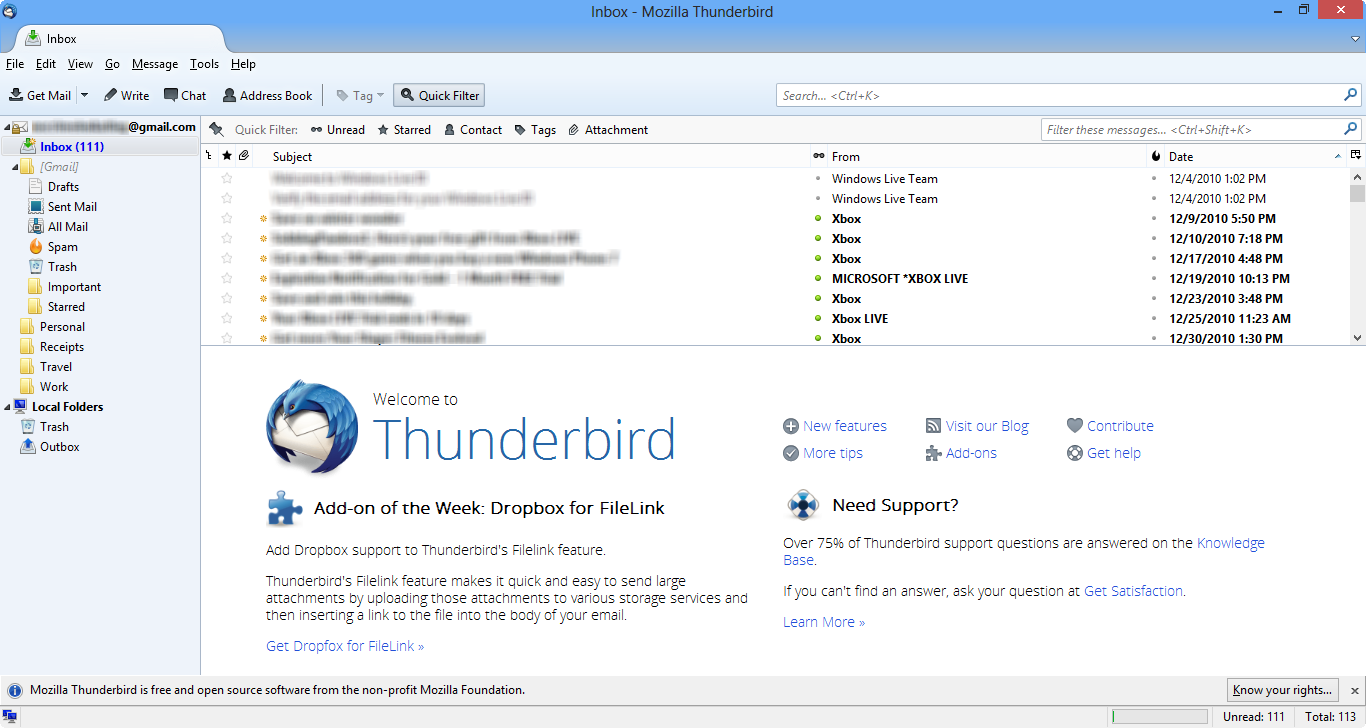
It would be my guess, that almost everyone who has used email, has seen or dealt with Microsoft's Outlook in some form or fashion. I, like many people I know, have been required to use it in the work environment, for example. However, another equivalent email provider that could relate to the same rankings of Outlook would be Mozilla Thunderbird. 

Now, while the name sounds incredibly daring and exciting, it is a little bit... "meh" to say the least. In fact, it kind of looks like something out of the late 90's or the early 2000's. It is simply boring, despite having another cool icon that looks like a vivid blue jay hugging an envelope. 


But looks aside, it does offer a good deal of convenience in the realm of its capabilities. I think my favorite aspect of Thunderbird, aside from the cute little birdie, is that it can have all of your various email inboxes, consolidated into one place, just like a bunch of suitcases stacked and tied together with a big leather strap. This handy feature makes checking your email extremely efficient, which in turn makes Thunderbird a valuable program.

The Open Source Zone-FireFox

With such a wide range of available, and free, Internet browsers, there are many popular choices to chose from. You have some of the big hitters, like Google Chrome, Safari, Internet Explorer, and more. For my first review of an open source browser, I chose to download and look into Mozilla Firefox. It is a widely popular Internet browser used by many, but until this project, I hadn't really used it much, as I am partial to my steady Freddy Safari.

When comparing the two, I did appreciate all of the customizations that could be played around with on Firefox, and the lay out and design was relatively simple, in my humble opinion. Additionally, the cool desktop icon that looks like a flaming cartoon fox wrestling with the planet Neptune was a cute, added perk.


However, at the end of the day, I don't really feel compelled to make the switch from my stock Apple Safari provider to Firefox. There wasn't anything wrong with the software in particular, but there wasn't really anything to write home about either... To me, even though there may be some claimed performance or operational differences between the two, Google looks pretty similar on both providers, so I wouldn't have a real reason to switch.


vs.


Wednesday, October 11, 2017

Artificial Intelligence- Full Steam Ahead for California (Good News for Tesla)

In another blog on the Top 10 Blogs Following Web 2.0, the details of California's DMV regulations regarding autonomous driving are laid out, as their new guidelines give the thumbs up for the testing and usage of such technology.

This is a major requirement that is necessary to move forward in order to develop and hone the technology of autonomous driving. It provides the opportunity to test in real life scenarios, which is a vital step towards bringing it further into reality.

Up to this point, Tesla's fully autonomous driving systems have been in "beta mode" in which the full capabilities have not been released, due to legislations and guidelines since the technology is so new, and the refinement of the tech itself, meaning that the systems continually learn and improve as it develops.


Tuesday, October 10, 2017

What's Next in the Transportation Industry

We are on the brink of witnessing a new wave in the automotive and land transportation industry. The change up of what we are about to see could be compared to the change up that occurred when cars ditched their horse "power" and started moving about with engines.

Tesla, a most notable name in new technology, is spearheading the movement towards leaving dirty ol' oil behind in the dust, when it comes to power. This power is incredibly efficient, especially when placed behind a vessel with four wheels. And don't for a second think that nixing a gasoline engine with all those cylinders and replacing it with a watermelon-sized electric motor means that you'd need extra space to merge onto the freeway; it is quite the contrary! In fact, there are tons of videos on Youtube that prove just how fast a Tesla is, outracing any supercar out there. (I especially love a race with Tesla's SUV against a Lamborghini Aventator ) But fastness aside, there are so many reasons that electric vehicles are better than ICE vehicles (internal combustion engine). Gas savings are just the ice burg, but beyond that, there are no more oil changes, transmission problems, blown gaskets, oil leaks, or any of the other maintenance issues that come with a gas engine that has so many moving mechanical parts. In a Tesla, there are approximately 20 moving parts to get it going and a standard ICE vehicle has around 10,000! So you can see how maintenance would be dramatically less. 

What's even more exciting is the impact that they are starting to make on the semi-truck industry. It is in it's infancy stages, but their first all-electric semi has been spied in California earlier this month. According to early witnesses, including long-time truck drivers who have seen it, it is a game changer. The semi is set to be revealed in November, but it is said to also provide autonomous driving capabilities which would be so much safer for everyone, since driving across the country for such long durations is incredibly tiresome to truck drivers with strict deadlines on their deliveries. That kind of technology would enable them to rest along the way, just as airplane pilots do, while their truck is on autopilot. Not a bad gig to run a big rig, if you ask me!

(photo courtesy of electrek.com)

In reviewing some of the blogs listed in the Top 10 Blogs Following Web 2.0, one in particular covered the up and coming technology of autonomous driving. The blog speaks about Seattle's plan to covert a portion of I-5, spanning up to Vancouver, to be a specialized highway made solely for autonomous vehicles. The plans are also set to gradually come into fruition over the next few years.

As the artificial intelligence for these systems grow more sophisticated, the way we travel will be changed forever. Simply put. There will be no more drunk drivers, long commutes and traffic jams will not be as dreary when you can sit back, take a nap, or conduct business on your lap top or personal electronic devises. Even yet, maybe the kids won't ask "are we there yet?" quite as often if you can turn your seat around and engage in a nice friendly game of Monopoly with them while you're all on your way to Disneyland for summer vacation. I think technology is definitely heading in the right direction!